
Choosing between a vented and ventless dryer trips up a lot of Canadian homeowners, and it’s easy to see why. Both types dry your clothes, but they work very differently, and the choice you make affects your energy bills, your safety, and even how your laundry room needs to be set up. If you’ve ever stood in an appliance store wondering which one actually makes sense for your home, you’re not alone. This guide breaks down exactly how each dryer type works, where each one shines, and what you need to do to keep whichever you choose running safely for years to come.
Table of Contents
- How vented dryers work and their practical implications
- How ventless dryers work and when they’re ideal
- Vented vs ventless dryers: Side-by-side comparison
- Safety and maintenance: What every homeowner must know
- Why choosing the right dryer matters more than you think
- Take the next step: Keep your dryer safe and efficient
- Frequently asked questions
Key Takeaways
| Point | Details |
|---|---|
| Dryer type affects home safety | Vented dryers require vent cleaning to prevent lint fires and keep homes safe. |
| Ventless suits small spaces | Ventless dryers work where venting outside isn’t possible, ideal for apartments or condos. |
| Efficiency and speed differ | Vented dryers dry clothes faster, while ventless models are often more energy-efficient but slower. |
| Maintenance is essential | Regular cleaning and checkups are critical for both vented and ventless dryers’ safe operation. |
How vented dryers work and their practical implications
With that confusion in mind, let’s start by looking at how vented dryers actually operate and what Canadian homeowners need to know about owning one.
A vented dryer is the type most Canadians grew up with. It generates heat using either electric coils or a gas burner, then pushes that heated air into the drum where your clothes tumble around. The heat causes moisture in the fabric to evaporate, and that warm, damp air gets pushed out of the machine through a duct that leads to the exterior of your home. The result is fast, powerful drying that handles large loads with ease.
As dryers.top explains, vented dryers heat air using electric coils or gas, tumble clothes to evaporate moisture, and expel hot moist air outside through a duct, enabling fast drying but requiring external venting and regular duct cleaning to prevent lint fires.
That last part is critical. The duct system that makes vented dryers so effective is also their biggest liability. Every load of laundry sends tiny fibres of lint through the duct along with the moist air. Over time, that lint accumulates inside the duct walls. If it’s not cleared out, it becomes a serious fire hazard. Lint is highly flammable, and a clogged duct restricts airflow, causing the dryer to overheat.
Here’s a quick summary of what defines a vented dryer:
- Uses electric coils or a gas burner to generate heat
- Tumbles clothes in a heated drum to evaporate moisture
- Expels moist air through a rigid or flexible duct to the outdoors
- Requires a dedicated external vent opening in an exterior wall
- Typically uses between 2.5 and 4 kWh of electricity per cycle
- Dries a full load faster than most ventless models
Vented dryers are best suited to detached homes, semi-detached houses, and townhouses where running a duct to an exterior wall is straightforward. If your laundry room is on the main floor or in a basement with an accessible exterior wall, installation is usually simple.
Regular dryer vent cleaning is not optional for vented dryer owners. It’s the single most important maintenance task you can do to protect your home from a dryer-related fire.
Pro Tip: If your vented dryer is taking longer than usual to dry a full load, that’s often the first sign of a clogged or restricted duct. Don’t ignore it. A dryer that runs longer uses more energy and builds up more heat, both of which increase your risk.
The energy consumption of vented dryers is worth noting. Electric vented models typically draw between 2.5 and 4 kWh per cycle, while gas models tend to cost less per load because natural gas is generally cheaper than electricity in most Canadian provinces. Either way, a well-maintained vented dryer with a clear, short duct run will always perform more efficiently than one with a long, kinked, or partially blocked duct.
How ventless dryers work and when they’re ideal
Now that we’ve explored vented dryers, let’s see how ventless dryers take a different approach that suits some homes better than others.
Ventless dryers solve a specific problem: what do you do when you can’t run a duct to the outside? Apartments, condos, older homes with complicated layouts, and basement suites often make traditional venting impossible or impractical. That’s where ventless technology steps in.
Instead of pushing moist air outside, a ventless dryer recycles it. There are two main types you’ll encounter in Canada.
Condenser dryers work by pulling warm, moist air from the drum and passing it over a cool surface called a condenser. The moisture in the air condenses into water droplets, much like how a cold glass sweats on a warm day. That collected water either drains through a hose or collects in a removable tank that you empty manually. The now-dry air is reheated and sent back into the drum to continue the cycle.

Heat pump dryers take this concept further by using a refrigerant system, similar to what you’d find in an air conditioner or refrigerator, to manage the heating and cooling process. This makes them significantly more energy efficient than both condenser dryers and traditional vented models. Heat pump dryers typically use around 1 to 2 kWh per cycle, roughly half the energy of a standard vented electric dryer.
Here’s what sets ventless dryers apart:
- Recycle heated air rather than expelling it outside
- Condenser models collect water in a tank or drain it away
- Heat pump models use a refrigerant loop for greater efficiency
- No need for an external vent or wall opening
- Gentler on fabrics because drying temperatures are lower
- Drying cycles are typically 15 to 30 minutes longer than vented models
- Lower fire risk because lint doesn’t accumulate in a long duct system
The longer drying time is the most common complaint from ventless dryer owners. If you’re used to a vented dryer knocking out a full load in 45 minutes, a condenser dryer taking 70 to 90 minutes can feel like a step backward. Heat pump models are even slower in some cases. For households that do laundry in the evening or overnight, this matters less. For families with heavy daily laundry demands, it’s a real consideration.
Pro Tip: If you’re buying a ventless dryer for a condo, look for a model with a direct drain connection rather than a removable water tank. Emptying a tank after every load gets old quickly, and forgetting to empty it means your dryer stops mid-cycle.
The fire safety advantage of ventless dryers is genuine. Without a long duct run, there’s far less opportunity for lint to build up in dangerous quantities. That said, ventless dryers still produce lint, and their internal filters and condenser units need regular cleaning to maintain efficiency and prevent overheating.
Vented vs ventless dryers: Side-by-side comparison
To decide which dryer fits your space, here’s how vented and ventless models stack up directly.
| Feature | Vented dryer | Ventless dryer |
|---|---|---|
| Installation | Requires external duct and wall vent | No external vent needed |
| Energy use | 2.5 to 4 kWh per cycle | 1 to 2 kWh (heat pump) |
| Drying speed | Fastest option | Slower by 15 to 30 minutes |
| Fire safety | Higher risk if duct not maintained | Lower risk overall |
| Maintenance | Annual duct cleaning required | Filter and condenser cleaning |
| Best for | Houses with exterior wall access | Apartments, condos, tight spaces |
| Upfront cost | Generally lower | Higher, especially heat pump |
| Fabric care | Higher heat, more wear on fabrics | Gentler, lower temperatures |
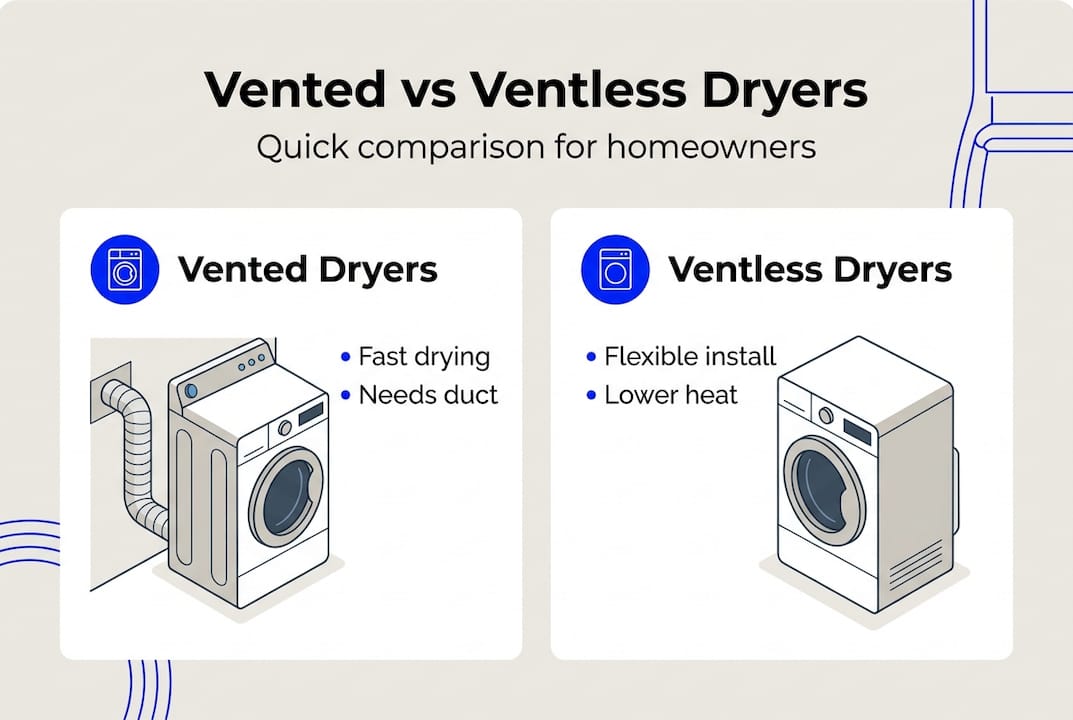
The table above makes the trade-offs clear. Vented dryers win on speed and upfront cost. Ventless dryers win on installation flexibility, long-term energy savings (particularly heat pump models), and fire safety. Neither type is universally better. The right choice depends on your home’s layout, your household’s laundry habits, and how much you’re willing to invest upfront versus over time.
One statistic worth keeping in mind: vented dryers are the fastest drying option, consuming 2.5 to 4 kWh per electric cycle, while heat pump ventless models can cut that energy draw nearly in half. Over a year of regular use, that difference adds up noticeably on your electricity bill.
When you’re weighing your options, it also helps to consult dryer safety experts who can assess your home’s existing setup and tell you what installation would actually involve. Sometimes a homeowner assumes venting is impossible only to discover a straightforward duct route they hadn’t considered.
Safety and maintenance: What every homeowner must know
No matter which dryer you choose, safe operation and proper upkeep are non-negotiable. Here’s what to keep in mind.
Dryer fires are a real and preventable risk in Canadian homes. The leading cause is lint buildup in vented dryer ducts. According to fire safety data, dryers are responsible for thousands of residential fires each year across North America, and the vast majority are preventable with routine maintenance. As noted by dryers.top, vented dryers require regular duct cleaning to prevent lint fires, a fact that many homeowners don’t take seriously until something goes wrong.
Maintenance checklist for vented dryer owners:
- Clean the lint trap after every single load, without exception
- Inspect the exterior vent flap every season to confirm it opens freely and isn’t blocked by debris, ice, or bird nests
- Check the duct for kinks or crushing, especially if the dryer has been moved recently
- Schedule a professional dryer vent cleaning process at least once a year, or more often if you do laundry daily
- Replace any plastic or foil accordion-style duct with rigid metal ducting, which is far safer and more durable
- Watch for warning signs: longer drying times, a burning smell, or a dryer that’s hot to the touch on the outside
Maintenance checklist for ventless dryer owners:
- Clean the lint filter after every load, just as you would with a vented model
- Clean the condenser unit every one to three months, following your manufacturer’s instructions
- If your model has a water collection tank, empty it after each use
- Check the drain hose periodically for blockages or kinks if your unit drains directly
- Wipe down the drum interior monthly to prevent residue buildup from fabric softeners
Pro Tip: Many homeowners with ventless dryers assume they’re off the hook for fire risk entirely. While the risk is significantly lower, a clogged internal filter can still cause a ventless dryer to overheat. Keep that filter clean.
The most dangerous dryer is one that seems to be working fine but is quietly accumulating lint or overheating. Both vented and ventless dryers need regular attention to stay safe.
One maintenance task that homeowners consistently overlook with vented dryers is the exterior vent cover. In Canadian winters, ice and snow can partially block the vent flap, restricting airflow and causing the dryer to work harder than it should. A quick visual check each season takes two minutes and can prevent a serious problem.
Knowing when to call a professional matters too. If you notice a burning smell, your clothes feel unusually hot after a cycle, or your drying times have increased significantly, stop using the dryer and get it inspected. These are not minor inconveniences. They are warning signs of a system under stress.
Why choosing the right dryer matters more than you think
Stepping back from the technical details, here’s why your dryer decision deserves more attention than it usually gets.
Most people spend more time choosing a paint colour for their laundry room than they do researching which dryer type actually suits their home. That’s a problem. The dryer you choose, and how well you maintain it, has a direct impact on your household’s fire risk, your monthly energy costs, and how long the appliance lasts.
We see this regularly in our work. Homeowners install a vented dryer in a condo because it’s what they’ve always had, then run a duct through a long, winding route that accumulates lint at every bend. Or they buy a ventless dryer for a large family home and find themselves frustrated by slow drying times. Both situations are avoidable with a bit of upfront thought.
The other thing we’d push back on is the idea that buying the right dryer is enough on its own. It isn’t. A well-chosen dryer that’s never serviced will eventually become a liability. The homeowners who get the most out of their appliances, and stay safest, are the ones who treat maintenance as a routine part of home ownership rather than something to deal with when something breaks. Our dryer safety services exist precisely because prevention is always less costly than repair.
Take the next step: Keep your dryer safe and efficient
If you’re ready to ensure your new or existing dryer performs at its best, here’s how to get help today.
Whether you’ve just installed a new vented dryer or you’ve been running the same machine for years without a duct inspection, there’s no better time to make sure everything is working safely. Our team at Dryer Vent Doctor provides professional dryer vent cleaning services for homeowners across Canada, using power vacuums and rotating brushes to clear lint and debris from the full length of your duct system.

We also walk you through our professional cleaning process so you know exactly what’s being done and why. Free estimates, easy online booking, and service you can trust. Your family’s safety is worth a phone call.
Frequently asked questions
Are ventless dryers less efficient than vented models?
Ventless dryers, particularly heat pump models, are generally more energy efficient per load than vented dryers, though they take longer to complete each cycle.
Do ventless dryers require outside venting?
No, ventless dryers do not require an external vent and can be installed in spaces without access to an exterior wall, unlike vented models that must expel moist air outside.
Is lint a fire risk with both dryer types?
Lint buildup in vented dryer ducts is a well-documented fire hazard if ducts aren’t cleaned regularly, while ventless dryers carry a much lower fire risk due to the absence of a long duct system.
Can I convert my vented dryer to ventless?
No, vented and ventless dryers use fundamentally different technology and cannot be converted from one type to the other.
